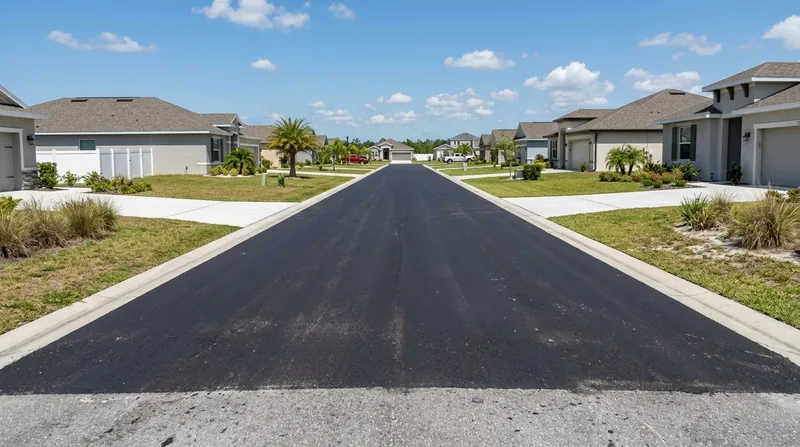




Private Road & HOA Paving in Daytona Beach demands a foundation built for the local ground. Subdivision streets west toward Port Orange and Ormond Beach sit on fine sandy soil that drains fast but offers little bearing strength, and the water table sits close to the surface, especially during the summer rainy season. Every private road and HOA street in the region needs proper grading, a solid aggregate base, and hot mix asphalt pitched to shed water after the near-daily afternoon storms. Flat terrain means standing water is the enemy, and salt air off the Atlantic oxidizes older surfaces on beachside approaches. We build the base, pour the asphalt, and pitch every section so your subdivision streets clear the rainy season and stay serviceable for years.
Why Private Road & HOA Paving Matters in Daytona Beach's Master-Planned Communities
HOA roads and private streets in Daytona Beach subdivisions carry more traffic than residential driveways but receive less maintenance oversight than municipal roads. The sandy soil beneath most mainland subdivisions between Daytona Beach and Port Orange does not compact reliably, meaning that without a properly engineered base, asphalt will fail in three to five years instead of ten to fifteen. Standing water after summer storms accelerates that failure, undermining the base from below. The cost of a full-depth replacement is four to five times the cost of building the base correctly the first time.
- We install a compacted aggregate base layer sized for the soil conditions and traffic load on your private road.
- We pitch every section of the asphalt so water runs off into drainage structures, not into the base.
- We use hot mix asphalt, the same material municipal roads are built with, because recycled millings and tar and chip will not hold up to HOA traffic.
- We coordinate with your HOA board and local building department so the finished road meets architectural standards and any local permitting requirements.
A properly built private road or HOA street carries resident traffic safely and keeps HOA special assessments for emergency repairs out of the budget.
Key info: Daytona Beach and Volusia County require permits for work on private roads that drain into public stormwater systems or that touch right-of-way. Verify your local requirements with the City of Daytona Beach or your county building department before you start. We help you navigate the permitting process.
How We Build Private Roads and HOA Streets in Daytona Beach
Private road paving starts with the ground. We grade the roadbed to establish proper slope, then we install and compact an aggregate base layer. The base is the load-bearing layer; without it, asphalt over sand fails in a few years. We then lay hot mix asphalt in lifts, compact each lift, and finish with a smooth riding surface. Pitch is built into every section so water drains, not pools. The entire job is coordinated with your HOA or property manager so traffic disruption is minimized and the finished road meets your community's standards.
- We meet with your HOA board or property manager to review the scope, timeline, and any architectural or drainage requirements.
- We perform a site survey and identify drainage paths and base conditions so we can specify the right thickness and tonnage.
- We stake out the road, grade the subgrade, and install the aggregate base layer in compacted lifts.
- We lay hot mix asphalt, compact it, and finish to the profile and pitch your engineer or HOA specifies.
- We coordinate with your local building department if permits are required and verify that the finished road meets local stormwater and driveway apron standards.
The result is a private road built to last, with clear drainage and a smooth, safe riding surface.
Example: A 400-foot private street in a Port Orange subdivision required a 6-inch compacted aggregate base and 2.5 inches of hot mix asphalt. The road was pitched at 2 percent so water runs to the curb and into the drainage structure at the end of the street. The project took five days, and the road is now serviceable for the next ten to twelve years.
Private Road and HOA Paving Methods and Approaches
| Approach | Description | Best for |
|---|---|---|
| Full-Depth Paving | Remove old asphalt or gravel, grade the subgrade, install compacted aggregate base, lay hot mix asphalt, and finish to slope and profile. | New private roads, complete replacement of failed roads, roads on poor soils that need a strong base. |
| Mill and Overlay | Remove the top 1.5 to 2.5 inches of existing asphalt, grade and compact the remaining base, and lay new hot mix asphalt. | Roads with sound bases and moderate surface wear, cost savings when the base is still good, faster project timeline. |
| Full-Depth Reclamation | Mix existing asphalt and base materials in place, re-grade, re-compact, and lay new hot mix asphalt on top. | Roads with failed bases where the old material can be recycled, cost savings through material reuse, environmental benefit of reduced hauling. |
| Gravel and Recycled Millings Roads | Grade and compact recycled asphalt millings or crushed gravel to a finished profile, with proper drainage and pitch. | Secondary or low-traffic private roads, temporary access roads, HOA budget constraints, roads on well-drained soils. |
Each approach has a cost profile and a best use. We assess your road's current condition, base quality, and HOA traffic patterns to recommend the method that gives you the best value and the longest serviceable life. Read more about asphalt milling and removal if your road is a candidate for mill and overlay.
Private Road & HOA Paving Cost in Daytona Beach: What to Expect
Private road and HOA paving in Daytona Beach typically starts at $15,000 for a short street or a single section, but most HOA projects run between $25,000 and $60,000 depending on the length of the road, the condition of the existing base, and whether you are doing full-depth paving or mill and overlay. A 400-foot private street with a new 6-inch base and 2.5 inches of hot mix asphalt will cost more than a 200-foot road with an existing sound base that needs only an overlay. The sandy soil in most Daytona Beach subdivisions means you cannot skip base preparation; that adds to the cost but is essential for durability.
Factors that affect the final cost include the length and width of the road, the thickness of the base layer, whether you are removing and replacing or overlaying an existing surface, site access and staging, and local permitting requirements. We provide a written estimate with tonnage and thickness specifications so you know exactly what you are getting. Visit our pricing page for a full breakdown of our rates and what drives the cost up or down.
Get two or three estimates from local paving contractors so you can compare scope, thickness, tonnage, and warranty language. The lowest price is not always the best value if it cuts corners on base preparation or uses thinner asphalt. We recommend asking every contractor for a written estimate that includes base thickness, asphalt thickness, and tonnage per square yard so you can compare apples to apples.
What to Look for When Hiring a Paving Contractor Near Daytona Beach
Choosing a paving contractor for your private road or HOA project is a significant decision that affects your community for a decade or more. Verify that any contractor you interview carries full insurance and is willing to provide a certificate of insurance naming your HOA as an additional insured. Ask for references from recent HOA or private road projects in the Daytona Beach area, and call those references to ask about the quality of the work, how the contractor handled scheduling and site access, and whether the road has held up well. Confirm that the contractor understands local permitting requirements and will help you navigate any county or city approvals needed before work starts.
- Request a written estimate that specifies base thickness, asphalt thickness, tonnage per square yard, and the method (full-depth, mill and overlay, or reclamation).
- Verify that the contractor has experience with HOA roads and understands the architectural and drainage standards your community requires.
- Check that the contractor is local to Daytona Beach or the surrounding area and has an established business address and local references.
- Ask about the workmanship warranty and what it covers, and get the warranty terms in writing.
- Confirm that the contractor will coordinate with your HOA board and local building department so permits are pulled and inspections are scheduled before work begins.
Honest guidance and local experience are the differentiators in this trade. Call us at (386) 267-8085 for a free, no-obligation estimate, or visit our contact page to request a site visit. We have been serving Daytona Beach and the surrounding communities since 2012, and we are ready to answer your questions about your private road or HOA paving project.
Private Road & HOA Paving in Daytona Beach: Pricing Guide
| Service | Price | Details |
|---|---|---|
| Private road or HOA street (200-400 feet, full-depth paving) | Starting at $15,000 | Includes grading, 6-inch aggregate base, 2.5 inches hot mix asphalt, pitch and drainage |
| Mill and overlay (existing road with sound base) | Starting at $12,000 | Includes milling, re-grading, 2-inch hot mix overlay, pitch correction, faster timeline |
| Full-depth reclamation and repave | Starting at $18,000 | Includes mixing existing materials in place, re-grading, 2.5 inches new hot mix, material reuse saves cost |
| Gravel or recycled millings road (secondary access) | Starting at $8,000 | Includes grading, compacted recycled asphalt or crushed gravel base, proper drainage, lower traffic roads |
| Complex or large-scale job (over 600 feet, difficult access, utility coordination) | On estimate | Site conditions, permitting, and scope require a site visit and written proposal before pricing |
| Estimate and site visit | Free | Written estimate with tonnage and thickness specs, response within 24 hours at (386) 267-8085 |
Indicative pricing, the exact cost depends on square footage, finish, and site access. Free personalized estimate within 24h at (386) 267-8085.


