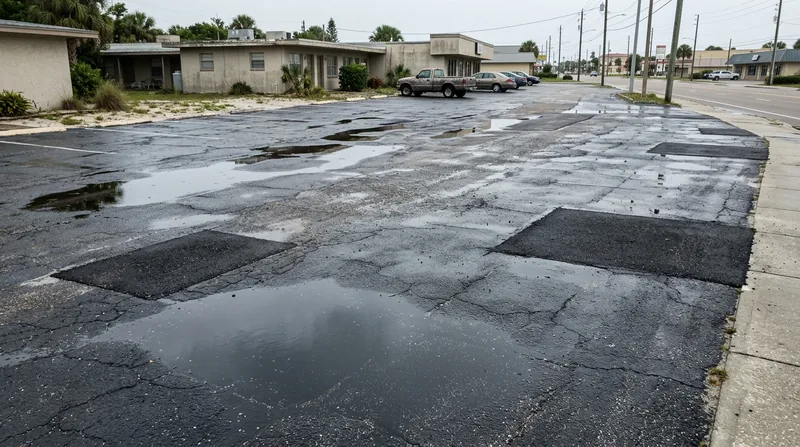




Parking Lot Repair & Resurfacing in Daytona Beach means cutting out failed pavement, rebuilding the base, and patching it flush so water drains instead of pooling. Daytona Beach parking lots sit on flat, sandy ground where the water table sits close to the surface, and near-daily afternoon storms from May through September leave standing water on any lot that isn't pitched correctly or whose base has failed. The Atlantic salt air and steady sun oxidize older asphalt, and hurricane season brings wind and flooding that undercut edges. We remove the failed section, rebuild the compacted aggregate base, and install new hot mix asphalt flush with the surrounding lot so it sheds water through the next storm season. This is not a cosmetic fix, it is structural repair that stops the pooling and the crumbling that leads to potholes and accelerated failure of the entire lot.
Why Parking Lot Repair Matters in Daytona Beach: Water Pooling and Base Failure
Daytona Beach's flat terrain and sandy soil create two problems that no parking lot escapes. First, water does not run off on its own, it pools after every afternoon storm and sits there for hours, weakening the base and accelerating cracking. Second, fine sandy soil offers almost no bearing capacity, so the asphalt rests on a compacted aggregate base that must be thick enough and properly pitched or it will fail in sections. When the base fails, the asphalt above it cracks, breaks apart, and creates potholes. Patching these holes one at a time is throwing money away if the base is gone. A proper repair cuts out the failed section, rebuilds the base, and installs new asphalt so the lot drains and holds.
- We identify failed sections by looking for alligator cracking, soft spots, and standing water that shows where the base has broken down.
- We cut out the bad pavement in a clean rectangle so the new patch edges are straight and the asphalt bonds properly.
- We rebuild the base with compacted aggregate and proof-roll it so it will not settle under traffic.
- We install new hot mix asphalt flush with the surrounding lot so water runs off instead of pooling.
- We pitch the repair to match the existing lot slope so drainage works across the entire surface.
A lot that pools water after every storm is losing base strength every time it rains, and every pothole that forms makes the problem worse. Repair now stops that cascade and adds years to the lot's life.
Key info: Daytona Beach and Holly Hill parking lots built on sandy soil with a high water table need proper pitch and a solid base or they will fail in sections within five to ten years. Standing water is the first sign that a repair is coming, not an optional cosmetic issue.
For more information on how Daytona Beach addresses stormwater and drainage in parking lots, see the City of Daytona Beach municipal code and permitting guidelines.
How We Repair and Resurface Parking Lots in Daytona Beach: Step by Step
Every repair starts with a site visit to measure the failed area, check the base, and understand the drainage pattern of the lot. We cut out the bad pavement in straight lines, haul it away, rebuild the base with compacted aggregate, and install new hot mix asphalt. The key is getting the base right, because a poor base will fail again in a few years. We proof-roll the base to ensure it is solid, then install the asphalt at the correct thickness and pitch so water runs off and the patch bonds to the surrounding pavement.
- We measure the lot and identify all failed sections, soft spots, and drainage problems so we understand the full scope.
- We cut out the failed pavement in clean rectangles with straight edges so the new asphalt will bond properly to the existing lot.
- We haul away the broken asphalt and any failed base material so we are starting with solid ground.
- We excavate to the proper depth for the new base, removing any soft or unstable soil.
- We install and compact the new aggregate base in lifts, proof-rolling after each lift to ensure it will not settle.
- We install hot mix asphalt at the correct thickness, pitched to match the lot slope so water runs off.
- We compact the new asphalt with a roller while it is hot so it bonds and will not crack prematurely.
A lot that has been repaired this way will shed water, hold under traffic, and last another ten to fifteen years before another repair or resurfacing is needed.
Local example: A small restaurant parking lot in South Daytona had pooling water in one corner after every storm. The base under that corner had failed, and two patches in the last two years had not held. We cut out the failed section, rebuilt the base, and installed new asphalt pitched to the lot's drain. The lot now sheds water, and the owner has not had a pothole in that spot since.
If your lot is larger or has multiple failed sections, a full asphalt resurfacing or overlay may be more cost-effective than multiple repairs. We will evaluate the lot and recommend the right approach.
Parking Lot Repair Methods: Patching vs. Resurfacing
| Approach | Description | Best For |
|---|---|---|
| Full-Depth Patching | We cut out the failed section, remove the old base, install new compacted aggregate, and pave with new asphalt flush to the surrounding lot. | One or two failed sections in an otherwise sound lot. Typical for water pooling in low spots or base failure under heavy traffic. |
| Pothole Repair | We clean out the pothole, tack the edges, and fill it with hot mix asphalt, compacting it flush with the surrounding surface. | Single potholes or a few scattered holes in a lot that is otherwise holding up. Quick turnaround, lowest cost per hole. |
| Asphalt Overlay | We mill or grind the top layer of the existing asphalt, inspect the base, and install a new layer of hot mix asphalt over the existing lot. | Lots with moderate cracking and alligator cracking across thirty to forty percent of the surface, where the base is still solid. |
| Full Lot Replacement | We mill the entire existing pavement, excavate and rebuild the base, and install new asphalt at the correct thickness and pitch. | Lots with extensive base failure, poor drainage, or widespread cracking affecting more than forty percent of the surface. |
Parking Lot Repair & Resurfacing Cost in Daytona Beach: What to Expect
A full-depth patch repair in Daytona Beach typically starts at $650 to $1,200 for a small section, depending on the size of the failed area, the depth of the base failure, and the tonnage of new asphalt required. A larger failed section or a lot with multiple repairs needed can run $2,000 to $5,000 or more. An overlay of a moderate-sized lot might run $1,500 to $4,000, and a full replacement depends on the lot size and base condition. The exact cost depends on how much base has failed, how much new asphalt is needed, and whether the lot needs regrading or new drainage work.
The most common cost drivers are the size of the failed section, the depth of base failure, the tonnage of new asphalt, and whether the lot needs regrading to improve drainage. A lot that pools water may need the entire surface pitched differently, which costs more than a simple patch. We provide a written estimate with tonnage and thickness specifications so you know exactly what you are paying for. Get two or three estimates from different contractors so you can compare the scope and the price, and make sure each estimate includes the tonnage of asphalt and the base thickness, not just a total dollar figure.
See our full pricing page for more detail on what different repair scopes cost and what affects the price.
Parking Lot Repair & Resurfacing Near Me: What to Look for When Hiring a Paving Contractor
Parking lot repair is a concrete, measurable job, and you should be able to see exactly what you are paying for. Get a written estimate that includes the tonnage of asphalt, the thickness of the base, and the square footage of the repair. Ask for references from other parking lots in Daytona Beach, South Daytona, or Ormond Beach that the contractor has repaired. Verify that the contractor is fully insured and ask to see the certificate. Check whether your lot is in a jurisdiction that requires a permit for the repair, and whether the contractor will help you navigate the permitting process. If your lot is in an HOA or a master-planned community, check the architectural rules to make sure the repair meets the standard for materials and finish.
Watch for red flags: a contractor who shows up at your door unsolicited with a price that is too good to be true, no written contract, a request for a large cash deposit, or an estimate with no tonnage or thickness listed. These are the classic signs of a paving scam. A legitimate contractor will provide a detailed written estimate, be happy to answer questions about the scope and the materials, and be willing to work with you on timing and permitting.
Call us at (386) 267-8085 or request a free estimate for your parking lot. We have been in business since 2012 and we are local to Daytona Beach, so we understand the drainage challenges and the sandy soil that makes this work different from paving in other parts of Florida. We will measure your lot, identify the failed sections, and give you a written estimate with tonnage and thickness so you know what you are getting.
Parking Lot Repair & Resurfacing in Daytona Beach: Pricing Guide
| Service | Price | Details |
|---|---|---|
| Single pothole repair | Starting at $150 | Cleaning, filling, and compacting one pothole flush with surrounding asphalt in Daytona Beach area |
| Full-depth patch repair | Starting at $650 | Cutting out failed section, rebuilding base, and installing new asphalt, typical size 100 to 200 square feet |
| Multi-section repair or overlay | Starting at $1,500 | Multiple failed areas or resurfacing moderate-sized lot, cost varies by total square footage and base condition |
| Full lot replacement or extensive regrading | On estimate | Complete milling, base rebuild, and new pavement installation requires on-site measurement and base assessment |
| Travel and site visit | Included | No separate charge for travel in Daytona Beach and surrounding areas including Holly Hill, Port Orange, and Ormond Beach |
| Written estimate | Free | Detailed estimate with tonnage and thickness specifications, response within 24 hours at (386) 267-8085 |
Indicative pricing, the exact cost depends on square footage, finish, and site access. Free personalized estimate within 24h at (386) 267-8085.


